

Here’s a surprising fact: 78 percent of organizations now use generative AI in at least one core business function. This isn’t just a trend—it’s a fundamental shift in how we handle information.
You’re facing a critical decision. Do you keep sending workloads to the cloud, or bring intelligence directly to where your information lives?
The answer reshapes your entire strategy. This architectural shift lets you process, analyze, and act at the source. No more round-trips to remote servers.
Your data infrastructure might be drowning in information but starving for real-time insights. Embedding smart capabilities directly solves that.
We’ll show you the concrete benefits. Think 67% faster query performance and major savings from preventing breaches. You’ll get millisecond response times.
This guide walks you through how it works. Learn why it outperforms cloud-only approaches and how to implement it without overhauling your existing setup.
You’ll discover the core components that make it tick. We’re talking specialized hardware, optimized models, and engines that deliver decisions instantly.
By the end, you’ll know exactly how to evaluate solutions and deploy them. Master this shift in data management and transform your operations.
Redefining Intelligence: The Shift from Cloud to Edge
Imagine your database making a critical decision, but it has to ask a server hundreds of miles away for permission. That’s the core limitation of a cloud-only strategy. We’re now shifting intelligence to the edge, where devices analyze and act on data in real-time.
Cloud AI vs. Embedded AI: A Comparative Look
It’s not about replacing one with the other. It’s about choosing the right tool. The table below clarifies the fundamental trade-offs.
| Feature | Cloud AI | Embedded AI |
|---|---|---|
| Latency | High (200-500ms round-trip) | Low (milliseconds) |
| Connectivity | Constant internet required | Operates offline |
| Data Privacy | Lower; data travels over networks | Higher; data stays on device |
| Processing Power | Elastic and massive | Constrained by local hardware |
Edge-First Approaches and Their Strategic Benefits
An edge-first strategy delivers instant action. You eliminate the performance-killing wait for a cloud response.
Privacy and security improve automatically. Sensitive data never leaves your devices, slashing interception risks.
You also cut bandwidth costs dramatically. Instead of streaming raw data, you only send vital insights. This is crucial for safety-critical applications where preventing a disaster beats responding to one.
Core Components of Embedded AI Systems
The magic of instant, local decision-making isn’t magic—it’s built on three tightly integrated layers.
Your intelligence hub needs hardware that captures signals, software that runs lean models, and an application layer that triggers action.
Optimized Hardware and Sensor Integration
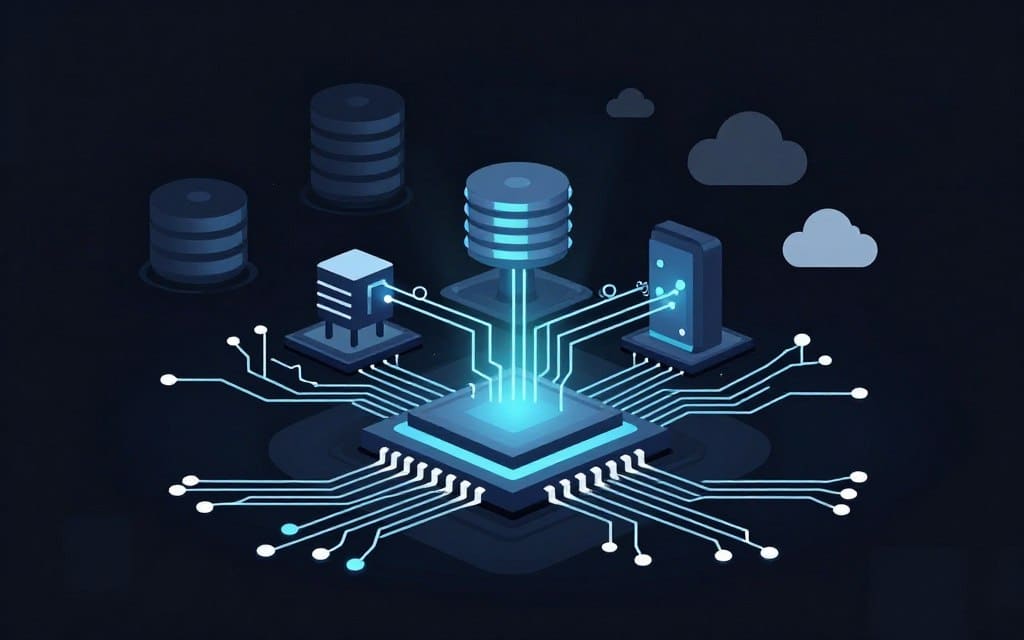
Standard CPUs can’t handle this workload efficiently. That’s why specialized chips like Neural Processing Units (NPUs) exist.
They’re purpose-built for the intense matrix math these systems demand.
Sensors are the frontline. They capture temperature, vibration, or visual data.
Even microcontrollers with tiny memory can now run smart models using TinyML frameworks.
Streamlined Algorithms and Real-Time Inference
You can’t use a massive cloud model here. Development relies on optimization tools like quantization and pruning.
Quantization cuts memory use by reducing numerical precision. Pruning removes redundant neural connections.
The inference cycle happens locally in milliseconds. Raw data enters, gets cleaned, and passes through the trained model.
A prediction is generated, triggering an automated response—all without leaving the device. This is real-time processing.
Leveraging Embedded AI in Database Systems for Real-Time Insights
Stop thinking of your database as a passive storage vault—it’s now an active intelligence engine. You’re generating insights the moment information arrives, without slow exports to external platforms.
This means continuous analysis, not nightly batch jobs. Your platform watches query patterns, workload shifts, and resource use in real time.
It automatically adjusts execution plans as conditions change. Machine learning models cut query latency by 67% compared to manual tuning.
That’s the difference between sluggish performance and seamless user experiences. You also move predictive analytics into your core data layer.
Score credit risk or forecast inventory needs within milliseconds of ingestion. Your entire management approach becomes proactive, not reactive.
The system turns self-optimizing through automation. It learns which indexes to build and when to cache results.
Automation even extends to diagnostics and capacity predictions. This intelligence lives where your data lives.
You finally eliminate the latency of complex pipelines. Decisions now happen at the speed your business demands.
Enhancing Performance, Security, and Governance
The true payoff of intelligent systems lies in a powerful trifecta: speed, safety, and control. Moving this capability directly into your data layer delivers concrete improvements across all three fronts.
Minimizing Latency and Reducing Costs
Real-time processing at the source slashes delay. You get millisecond responses, not 500ms cloud round-trips.
This directly boosts application performance and user experience. You also cut bandwidth costs immediately.
Transmitting only vital insights—not raw streams—drives major efficiency gains. The table below shows the impact.
| Metric | Traditional Cloud | With Local Intelligence |
|---|---|---|
| Query Response Time | 200-500ms | 5-10ms |
| Network Data Transfer | High (Raw Streams) | Low (Insights Only) |
| Operational Cost Impact | Higher Bandwidth Fees | Reduced Transmission Costs |
Ensuring Data Privacy and Compliance
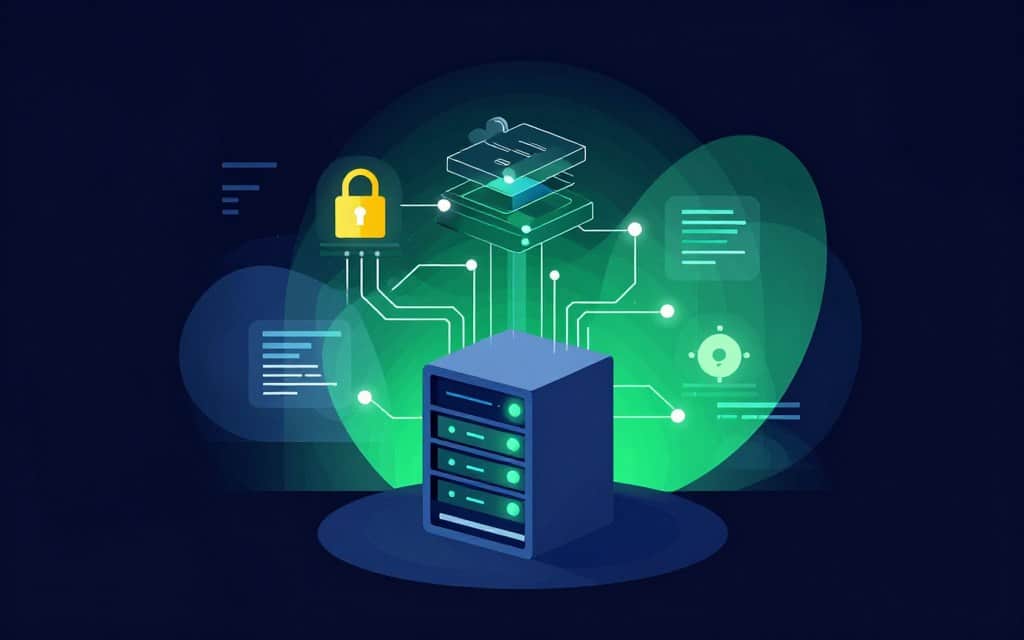
Security improves when information never leaves your controlled environment. There’s no transmission, so interception risk plummets.
The system inherits your existing governance and compliance frameworks automatically. It doesn’t create a separate audit burden.
Real-time monitoring learns normal behavior and flags anomalies instantly. This proactive approach is key for using AI for database optimization securely.
It also tackles shadow data—a major blind spot. IBM’s 2024 report found 35% of breaches involved it, costing $5.27 million on average.
The result? Stronger security, simplified governance, and enforceable compliance—all built into your core infrastructure.
Overcoming Challenges and Integrating with Legacy Architectures
Your biggest roadblock to smarter operations isn’t a lack of technology—it’s your existing infrastructure. Legacy architectures, built on siloed data and rigid schemas, actively fight the fluidity intelligent processing demands.
Successful integration needs both technical restructuring and organizational alignment.
Modernization Strategies for Seamless Integration
You can’t just bolt new capabilities onto old systems. Phased modernization is your path forward.
Start with a high-value use case for quick ROI. Then expand gradually. Data standardization becomes critical—your models need clean, consistent feeds.
Middleware can bridge gaps temporarily. Sustainable solutions, however, require modernizing your core data layer.
| Aspect | Legacy Data Layer | Modernized for Integration |
|---|---|---|
| Data Architecture | Siloed, batch-oriented | Unified, event-driven streams |
| Access Pattern | Limited APIs, static | Open APIs, real-time feedback |
| Team Structure | Separate functional silos | Cross-functional teams |
| Upgrade Path | Big-bang, high-risk | Iterative, value-driven phases |
Cross-functional teams are non-negotiable. Database experts must work alongside data scientists and infrastructure engineers.
This collaboration tackles complex tasks as one unit. New skills are part of the deal—traditional roles must evolve.
The organizations succeeding aren’t those with the newest tech. They’re the ones with clear governance and empowered, collaborative teams.
Real-World Applications: From Industrial Automation to Smart Healthcare
Forget hypotheticals—these intelligent applications are already delivering tangible results in factories, hospitals, and banks.
They turn raw information into immediate action. Your operations gain speed and reliability you can measure.
Industry-Specific Use Cases and Success Stories
In factories, sensors catch vibration anomalies early. This predictive maintenance cuts downtime by 30-50%.
Healthcare wearables monitor heart rhythms offline. They alert users to dangerous patterns without cellular service.
Financial firms like HSBC analyze millions of transactions. Machine learning spots subtle fraud signals in real time.
E-commerce giants deliver personalized suggestions instantly. Their models react to your browsing as it happens.
| Industry | Core Application | Key Benefit | Business Impact |
|---|---|---|---|
| Manufacturing | Predictive Maintenance | Catches machine failures early | 30-50% less downtime |
| Healthcare | Continuous Patient Monitoring | Immediate anomaly alerts | Earlier intervention, better outcomes |
| Finance | Fraud Detection | Spots complex pattern changes | Fewer false positives, stronger security |
| Retail | Real-Time Recommendations | Personalizes user experience | Higher conversion rates |
Implementing Practical AI-Driven Solutions
These solutions share powerful capabilities. They make decisions locally, without waiting for the cloud.
They operate reliably anywhere, even offline. This delivers faster insights directly to your teams.
The result is smarter automation and a superior experience for your end users. Your business gains a true competitive edge.
Charting New Horizons: The Future and Impact of Embedded AI
We’re witnessing a fundamental shift: powerful generative capabilities are moving from massive data centers to the devices in your pocket. This isn’t about bigger cloud models—it’s about smaller, distilled language models running locally.
These compact models deliver sophisticated capabilities like natural language interfaces and real-time content generation. Your tools will become conversational partners, working offline to protect privacy.
Deep integration means your systems gain self-tuning intelligence. They’ll adapt to workload patterns automatically, boosting efficiency for your teams.
Security remains paramount. 57% of CEOs cite data security as a top barrier. Local solutions mitigate this risk by keeping information on-device, preventing “shadow AI” and simplifying governance.
The result? Businesses that master this development will make faster decisions, offer superior user experience, and gain a lasting competitive edge. The time to act is now.