

Your company’s tools—CRM, analytics, product logs—generate a flood of information. Centralizing it is a start, but unlocking its true power hinges on getting the architecture right.
A poorly planned structure turns your central repository into a sluggish data swamp. Teams lose faith in the numbers, and every new data source becomes a firefight.
We’ll guide you through a battle-tested approach used by companies like LVMH and bank99. You’ll learn to align business goals with technical choices, from dimensional modeling strategies to robust governance.
This isn’t theory. It’s a practical blueprint to build a system that scales, delivers fast insights, and becomes a genuine competitive advantage.
Aligning Business Needs with Data Warehouse Strategy
Before a single line of code is written, your project’s success hinges on a crucial alignment phase. This foundational step connects your company’s ambitions directly to your technical build.
Don’t collect data just to have it. Every piece of information must serve a specific, measurable goal.
Setting Clear Business Objectives
Vague goals create ineffective systems. Instead of “we need better analytics,” define a tangible outcome.
Aim to reduce weekly sales report preparation from three hours to thirty minutes. Or identify high-value customers before they churn.
These specific targets dictate everything that follows. They ensure your warehouse solves real problems.
Defining Key Data Requirements
Once objectives are set, pinpoint the exact information you need. This determines which source systems to connect first.
You might prioritize sales transactions from Shopify and customer profiles from HubSpot CRM. Combining this data unlocks powerful insights.
Follow these steps to solidify your plan:
- Map measurable business outcomes to specific data sources.
- Assign clear ownership for data quality, security, and pipeline management.
- Revisit these requirements quarterly as your business evolves.
This alignment ensures your data warehouse becomes a trusted asset, not just another repository.
Choosing the Right Data Model for Optimal Performance
Your modeling decisions today will either accelerate insights or create reporting bottlenecks tomorrow. The structural approach you select determines how quickly your teams can answer critical business questions.
Evaluating Star, Snowflake, and Data Vault Schemas
Ralph Kimball’s dimensional modeling organizes information into fact and dimension tables. This creates intuitive structures that mirror how your company operates.
The star schema delivers blazing-fast query performance for daily reporting. It uses a central fact table surrounded by descriptive dimension tables.
Snowflake schemas normalize dimension tables further to reduce redundancy. This approach suits complex organizational structures but requires more joins.
Data Vault modeling offers exceptional flexibility for enterprises facing constant change. Its hub-link-satellite structure captures complete historical tracking.
Matching Models with Business Processes
Align your model choice with specific operational needs and team capabilities. Sales dashboards thrive with simple star schemas for immediate visibility.
Regulated industries benefit from Data Vault’s comprehensive audit trails. Many organizations implement hybrid approaches for balanced agility and speed.
Document your structural rationale to maintain clarity across teams. This ensures everyone understands why certain design decisions were made.
Integrating Data Effectively Through ETL/ELT Strategies
Your data integration approach determines whether insights arrive in minutes or get stuck in processing limbo. The movement of information from scattered sources to your analytical platform requires careful planning.
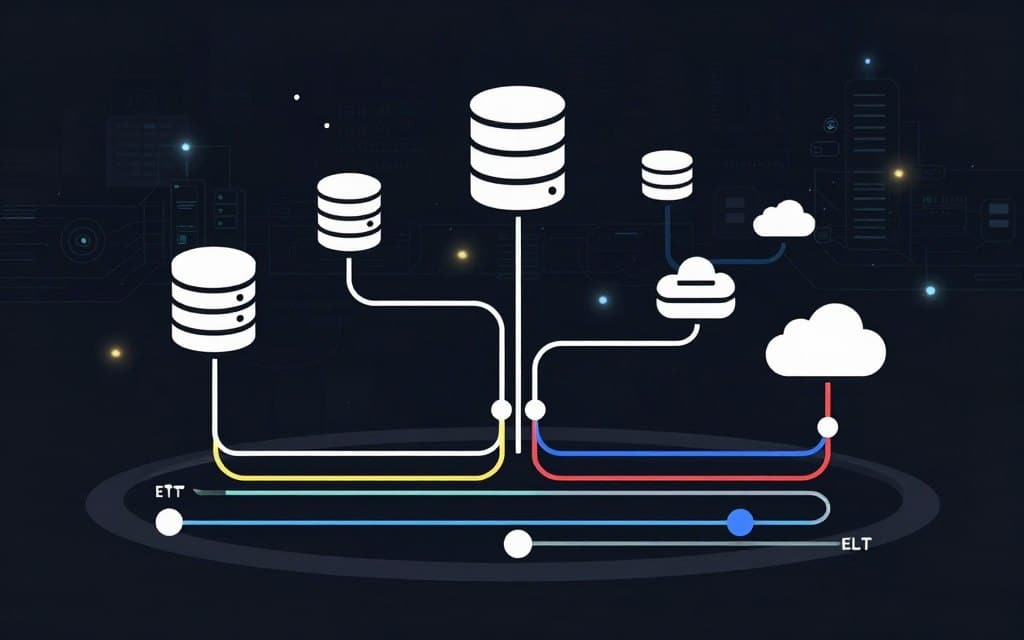
ETL processes transform data before loading it into your warehouse. This gives you strict control over quality and business rules enforcement.
ELT flips this sequence by loading raw information first. Transformations happen inside your analytical environment using its powerful compute resources.
Cloud platforms like BigQuery and Redshift excel with ELT approaches. They handle large-scale transformation workloads efficiently without external processing.
Automated pipelines eliminate the maintenance nightmare of custom scripts. Tools with pre-built connectors ensure continuous data flow from systems like Salesforce and Shopify.
LVMH unified reporting across luxury brands using automated integration. Each brand maintained different tools while achieving centralized visibility.
Design your transformation logic in small, testable steps. This makes debugging easier than troubleshooting one massive query.
Build retry mechanisms and monitoring into your pipelines. They’ll pause and alert you when source systems experience downtime.
Idempotent workflows ensure consistent results during reruns. Your warehouse maintains integrity even when jobs execute multiple times.
Your integration strategy directly impacts reporting reliability. Choose approaches that scale with your growing data needs.
Ensuring Data Quality and Robust Validation Processes
Garbage in, garbage out—this old computing adage becomes painfully real when flawed information corrupts your business intelligence. One incorrect email format can break customer segmentation. A negative revenue value throws off quarterly forecasts.
Your teams need to trust the numbers they see. That trust starts with rigorous validation built directly into your pipelines.
Automated Data Checks and Standardization
Set up automatic validation rules that catch errors before they reach analysts. Email addresses must contain “@” symbols. Timestamps need valid date formats. Product IDs cannot be null.
Standardize fields across all sources from day one. Use consistent formats for dates, currencies, and time zones. Mixing local time with UTC makes joins impossible and trends misleading.
Build these quality checks into your ETL or ELT workflow. Tools like Fivetran’s integration with dbt automate transformation and validation simultaneously.
| Check Type | Example | Business Impact |
|---|---|---|
| Format Validation | Email contains “@” | Prevents broken customer communications |
| Range Validation | Revenue ≥ 0 | Ensures accurate financial reporting |
| Uniqueness Check | Order IDs are unique | Prevents inflated sales metrics |
| Completeness Check | Customer names populated | Maintains reliable customer analytics |
Profile your information continuously to catch silent errors. Monitor row counts, null values, and missing fields. Sudden drops in daily orders signal upstream issues.
Track quality metrics like completeness and uniqueness as measurable KPIs. This proves to stakeholders that your system delivers trustworthy insights.
Implementing Incremental Load Strategies and Change Data Capture
Modern analytics demand near-instant updates, making incremental loading strategies essential for competitive advantage. Full table reloads waste resources and delay insights.
This smarter approach processes only changed information since your last sync. It keeps your analytical environment current without overwhelming your systems.
Benefits of Targeted Data Extraction
Change Data Capture (CDC) identifies modifications in your source systems. It extracts new orders, updated profiles, or inventory changes.
This targeted method cuts processing time from hours to minutes. Your network load decreases significantly, and cloud costs become predictable.
E-commerce platforms use CDC to sync stock levels in near real-time. This prevents overselling across all sales channels.
Optimizing Pipeline Efficiency
Incremental strategies scale effortlessly as your business grows. Whether processing thousands or millions of records, CDC maintains consistent performance.
You can update your analytical environment hourly instead of daily. This freshness supports operational decisions like fraud detection and dynamic pricing.
Build auditing into your pipeline to track every change captured. Test failure recovery to ensure you can resync from the last checkpoint.
Automated tools handle CDC logic across hundreds of connectors. They follow best practices for organizing library databases to maintain system integrity without manual coding.
Designing a Scalable and Secure Data Warehouse Architecture
Your warehouse’s architecture forms the bedrock of its entire operational life. This foundational choice dictates how your system grows, performs, and protects information.
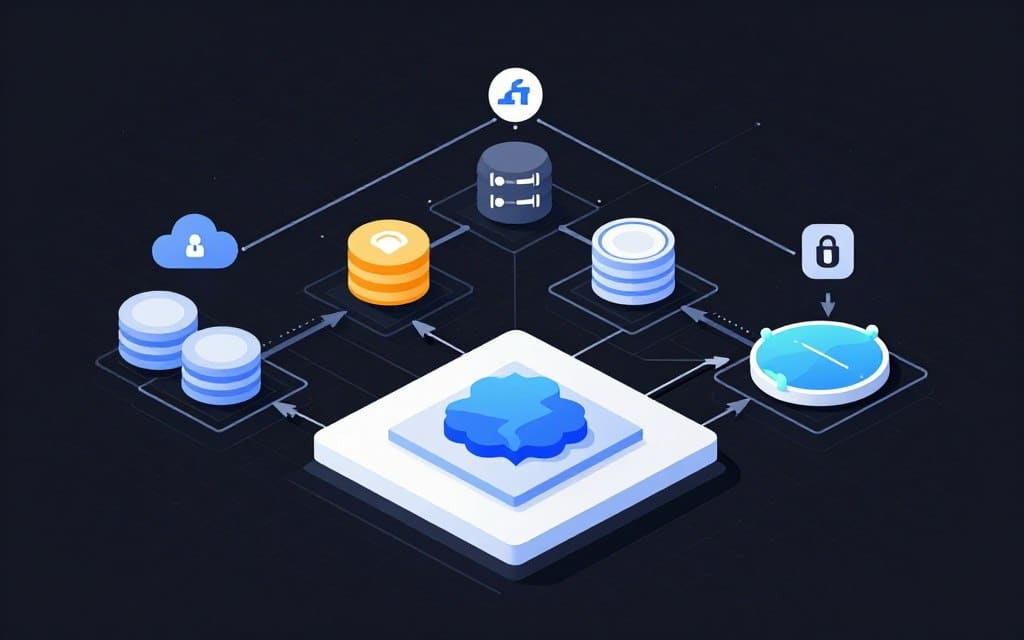
Modern platforms have moved beyond rigid, on-premises setups. They now embrace flexible models that separate storage from processing power.
Cloud, On-Premises, and Hybrid Considerations
You have three primary paths for your system’s foundation. Each offers distinct advantages for control, cost, and compliance.
Cloud platforms like Snowflake and BigQuery provide immense scalability. You pay only for the resources you actively use.
On-premises solutions keep everything within your own data center. This grants maximum control for highly regulated industries.
Hybrid models blend both worlds. They keep sensitive records on-prem while leveraging cloud power for analytics.
| Architecture Type | Key Advantage | Ideal Use Case |
|---|---|---|
| Cloud | Elastic scaling & cost-efficiency | Fast-growing companies with distributed teams |
| On-Premises | Total control & data sovereignty | Banks, healthcare providers with strict compliance needs |
| Hybrid | Balanced flexibility and security | Organizations migrating from legacy systems |
Consider Austrian bank bank99. They consolidated legacy systems into a unified, cloud-native platform. This improved performance and simplified governance.
Always embed security from the start. Encrypt data and set granular access controls, regardless of your chosen platform.
Leveraging Best Practices for Data Warehouse Schema Design for Maximum Performance
When designing your reporting foundation, the schema approach you select becomes the difference between frictionless insights and analytical bottlenecks. The right structural pattern delivers lightning-fast responses to complex business questions.
Adopting the Ideal Schema for Reporting
The star schema deliberately simplifies your data model for superior query speed. It centers around fact tables that connect directly to descriptive dimension tables.
This approach minimizes complex joins that slow down business intelligence tools. Your analysts get answers faster without navigating multiple table relationships.
Use surrogate keys—system-generated integers—as primary keys in your dimension tables. This protects your warehouse from upstream source system changes.
Plan for historical tracking with Slowly Changing Dimensions from the start. Choose between Type 1 (overwrite) and Type 2 (preserve history) based on your analytical needs.
Create conformed dimensions that multiple fact tables can share. Standardized date or product tables ensure consistency across all reports.
Document your structural decisions so team members understand the rationale behind each choice. This maintains clarity as your analytical environment evolves.
Managing Metadata and Ensuring Transparent Data Lineage
The difference between a trusted analytical platform and a data black hole lies in transparent data lineage. Your teams need to understand where numbers originate and how they transform.
Metadata describes your information’s structure, content, and origin. Lineage tracks its journey from source systems through transformations to final reports.
Building a Centralized Data Catalog
Deploy a centralized catalog tool like Collibra or Alation. This creates a single searchable repository for all your contextual information.
Automate metadata capture instead of manual documentation. Tools scan your pipelines and BI dashboards to build lineage graphs automatically.
Financial institutions use lineage to prove regulatory calculations to auditors. They trace numbers back through every transformation step to original records.
| Metadata Type | Key Components | User Benefit |
|---|---|---|
| Technical | Column names, data types, refresh schedules | Pipeline maintenance and troubleshooting |
| Business | Definitions, ownership, quality rules | Confident analysis and decision-making |
| Operational | Usage statistics, performance metrics | Resource optimization and planning |
Marketing teams should quickly discover customer segmentation tables. They need to understand definitions and see refresh dates.
Use lineage for impact analysis before making changes. The map shows every downstream report affected by modifications.
Optimizing Storage, Indexing, and Query Efficiency
Slow dashboards and sluggish queries aren’t just annoyances—they’re clear signals your storage and indexing need attention. When responses drag, your teams lose faith and productivity plummets.
Large, unorganized tables often cause these bottlenecks. Older information can clog the system, forcing every search to scan irrelevant historical records.
Effective Table Partitioning and Compression Techniques
Break massive tables into smaller, logical chunks. Partition by time—like month or year—or by category, such as product line.
A query for “this month’s sales” then scans only the current partition. This simple change slashes response times from minutes to seconds.
Enable compression to shrink your data footprint. Compressed information loads faster and costs less to store.
Improving Query Speed Through Strategic Indexing
Create indexes on columns your team searches frequently. Think of an index as a book’s table of contents for your database.
It guides the system straight to the needed rows. Searches by customer ID or product name become instant.
Use tiered storage to balance cost and speed. Keep recent data in fast “hot” storage for daily analysis.
Archive older records to cheaper “cold” storage. This approach maintains high performance for operational needs.
Monitor your query performance regularly. Identify slow searches and tune your structures iteratively for ongoing efficiency.
Governing Data with Strong Security and Access Controls
The final pillar of a trustworthy analytical system isn’t about speed or structure—it’s about ironclad control. Without it, your central platform becomes a liability, exposing sensitive customer details and violating compliance rules.
Strong governance protocols protect your most valuable asset: reliable information.
Enforcing Rigorous Data Governance Protocols
Start by encrypting everything by default, both at rest and in transit. Modern integration tools make this simple to implement from day one.
Anonymize sensitive fields before analysis. Show only the last four digits of a credit card or hash customer names.
Set precise, role-based access controls. Your finance team doesn’t need to see marketing campaign metrics.
Review these permissions quarterly. Stale access is a common security hole when people change roles or leave the company.
Establish a data stewardship council with members from business and IT departments. These stewards define rules and resolve quality issues, creating shared ownership.
Log every sync and schema change automatically. This creates an audit trail for compliance with frameworks like SOC 2 and HIPAA.
Governance is a continuous discipline, not a one-time setup. Regular audits and policy updates maintain trust in your analytical platform.
Bringing It All Together for a Future-Ready Data Warehouse
Building a resilient analytical foundation isn’t about chasing perfection—it’s about creating a system that grows with your evolving business needs. You need a warehouse that delivers value today while adapting to tomorrow’s challenges.
These proven approaches form a complete strategy. Align technical choices with real-world outcomes, automate integration pipelines, and embed governance from the start. This holistic method prevents costly rebuilds down the road.
Your investment in proper architecture becomes a genuine competitive edge. As data volumes explode and analytical demands intensify, quality design ensures smooth scaling and reliable insights.
Focus on transforming raw information into confident decision-making. A well-structured warehouse moves beyond simple storage to become your company’s strategic intelligence platform.