

Are your applications struggling with stale information because your data can’t keep up? Traditional poll-based methods constantly ask your systems for updates, creating lag and unnecessary strain.
This approach delivers outdated results and hurts performance. It’s a frustrating cycle that costs you real opportunities.
There’s a better way. Imagine a system where every data change instantly triggers actions across your entire architecture. This is the power of an event-driven approach.
Companies like Netflix and Uber already rely on this model for real-time personalization and fraud detection. You can build systems that scale gracefully and respond to customer needs instantly.
We’ll show you how modern patterns transform traditional setups into responsive, real-time powerhouses. You’ll eliminate polling overhead while maintaining rock-solid data consistency.
Rethinking Data Integration with Event-Driven Architecture
You’re likely facing a critical choice between data freshness and system performance right now. Traditional integration methods force this impossible tradeoff. There’s a better way forward.
Challenges with Poll-Based ETL
Poll-based ETL creates a vicious cycle. You need current information, but frequent queries crush your source systems. Those “efficient” delta scans often read entire tables.
Your production environment already handles user traffic. Adding massive batch jobs competes for the same resources. This degrades application experience and increases costs.
Even hourly updates leave your information stale. This approach cannot support real-time use cases like fraud detection or personalized experiences. Your data becomes outdated immediately after each job runs.
Benefits of Real-Time Data Streaming
Modern architecture eliminates polling waste entirely. It captures modifications as they occur, not hours later. You stream changes continuously to downstream consumers.
This method adds zero load to your production systems. You achieve sub-second latency while reducing strain. Real-time streaming isn’t optional anymore—it’s essential for competitive applications.
| Approach | Data Freshness | System Load | Real-Time Capability |
|---|---|---|---|
| Poll-Based ETL | 12-24 hours stale | High (full table scans) | None |
| Event-Driven Streaming | Sub-second updates | Zero added load | Full support |
| Hybrid Method | 1-4 hours delayed | Moderate impact | Limited functionality |
The benefits are immediate. You’ll build features that poll-based competitors cannot match. Your systems will scale gracefully while maintaining perfect data consistency.
Evolution of Database Schemas in Modern Systems
Information management has evolved from periodic updates to continuous real-time streaming. The old batch-processing mindset treated your storage as a fortress—data entered, sat idle, and only left during scheduled extraction windows.
Modern applications can’t tolerate this latency. You need structures that react instantly to every change as it occurs.
From Relational to Real-Time Approaches
Relational systems dominated for decades by guaranteeing consistency. But this came with an assumption: you’d process everything in batches later.
The breakthrough came when message queues and event streams matured. These technologies now handle production workloads reliably and cost-effectively.
You don’t need to abandon your existing PostgreSQL or MySQL setup. The evolution involves augmenting traditional models with change capture mechanisms.
Think of your storage as an active broadcaster rather than a passive repository. It remains the single source of truth while streaming modifications to downstream consumers instantly.
This architectural shift maintains ACID guarantees while feeding real-time analytics and microservices simultaneously. Your systems gain responsiveness without sacrificing reliability.
Mastering Event-Driven Database Schema Design Through Best Practices
Success with real-time architecture hinges on thoughtful planning before you publish your first event. You can’t just broadcast every database change—that creates noise and overwhelms downstream services.
Focus on meaningful state transitions that matter to your business logic. Your event schemas become contracts between services. Change them carelessly and you’ll break integrations.
Find the right balance for payload design. Include enough context so consumers can act independently. Avoid duplicating entire tables in every message.
Governance matters from day one. Establish naming conventions and define ownership boundaries. Create a schema registry before multiple teams publish incompatible events.
| Practice | Effective Approach | Problematic Pattern |
|---|---|---|
| Event Selection | Meaningful business transitions | Every database change |
| Payload Design | Essential context only | Full table duplication |
| Schema Evolution | Backward-compatible changes | Breaking existing consumers |
| Governance | Early registry implementation | Reactive cleanup later |
Get these fundamentals right early. Your system will scale smoothly without technical debt. Clear patterns for handling changes ensure long-term maintainability.
Leveraging Change Data Capture for Real-Time Data Flow
Imagine streaming real-time changes directly from your production systems with zero performance impact. Change Data Capture (CDC) makes this possible by tapping into your existing database logs. You get instant updates without modifying your application code.
This approach captures every insert, update, and delete as it happens. Your data flows continuously to downstream consumers with sub-second latency. It’s pure infrastructure magic that eliminates polling overhead.
Using CDC in MySQL and PostgreSQL
Setting up CDC requires minimal configuration changes. For MySQL, enable binlog with row-based format. PostgreSQL uses logical decoding with wal_level set to logical.
Both systems already maintain these logs for crash recovery. CDC tools simply read these files as they’re written. You’re leveraging existing infrastructure rather than adding new processes.
Minimizing Database Load with Log-Based Solutions
Log-based CDC adds almost zero load to your production environment. The database writes logs regardless of whether you read them. Reading these files consumes minimal resources.
Tools like Debezium connect as database replicas. They transform each change operation into structured events. Your systems capture only actual modifications—no full table scans.
Companies like Netflix and Uber process billions of events daily using this foundation. You can achieve the same scalability without compromising performance. It’s the modern approach to real-time data integration.
Transactional Outbox Pattern for Reliable Event Publishing
What happens when your database update succeeds but the event notification fails—leaving your entire system out of sync? This dual-write problem threatens data integrity across your services.
The Transactional Outbox pattern eliminates this risk. You store both business data and event records in the same transaction. This guarantees atomic consistency—either both succeed or both fail.
Ensuring Atomic Data and Event Consistency
Your service writes to an “outbox” table alongside normal business tables. The transaction commits both changes simultaneously. If it rolls back, neither survives.
A separate relay process then publishes these events to your message broker. This decouples delivery from your main transaction flow. You eliminate complex distributed transactions.
Handling Event Duplicates Effectively
The relay might publish the same event twice if it crashes mid-process. Your consumers must handle duplicates gracefully.
Implement idempotency checks on the consumer side. Track processed event IDs to ignore repeats. This ensures reliable processing despite occasional duplicate messages.
| Approach | Consistency Guarantee | Complexity | Consumer Requirements |
|---|---|---|---|
| Dual-Write (Direct) | None – risk of inconsistency | High – distributed transactions | Basic processing |
| Transactional Outbox | Atomic – all or nothing | Medium – single transaction | Idempotent consumers |
| Event Sourcing | Strong – events as source | High – architectural change | Event replay capability |
This pattern delivers rock-solid reliability for your event publishing. It’s a practical solution for modern systems requiring guaranteed delivery. Learn more about implementing this in our comprehensive event sourcing guide.
Harnessing Logical Decoding in PostgreSQL for Seamless Integration
Your PostgreSQL instance already maintains detailed logs—logical decoding lets you harness them for real-time integration. This feature transforms the write-ahead log into structured change events that external tools consume instantly.
You achieve continuous data streaming without modifying your application code. The approach captures every modification as it commits to your system.
Configuring Logical Decoding Settings
Start by setting wal_level=logical in your postgresql.conf file. This tells PostgreSQL to include sufficient information for row-level change reconstruction.
Create a replication slot—essentially a bookmark in the WAL. Attach a decoding plugin like wal2json or the built-in pgoutput. These tools transform binary log entries into JSON or logical replication format.
Debezium’s PostgreSQL connector leverages this mechanism beautifully. It creates a replication slot, takes an initial consistent snapshot, then streams every subsequent change as an event.
On managed platforms like Google Cloud SQL, enable logical decoding through configuration flags. Use cloudsql.logical_decoding rather than editing postgresql.conf directly.
Create publications to filter which tables get streamed. This reduces noise and bandwidth—only emit events for tables that matter to your downstream consumers.
The setup requires a dedicated replication user with appropriate permissions. Once configured, the stream flows continuously with minimal overhead on your production workload.
Utilizing MySQL Binlog for Continuous Change Data Capture
MySQL’s binary log holds a hidden superpower for real-time data integration. This log records every write operation in sequential order. You can tap into this stream for immediate change data capture.
Tools like Debezium connect as replicas to read the binlog. They transform each row-level modification into structured events. These events then flow to downstream systems like Kafka for processing.
Optimizing MySQL Configuration for Binlog
You’ll need two key settings in your my.cnf file. First, enable logging with log_bin = ON. Second, set binlog_format = ROW.
Row-based format is essential. It captures the actual data values changed, not just the SQL statements. This provides the complete context needed for your streaming applications.
The performance impact is minimal. MySQL writes the binlog for replication and recovery anyway. You’re simply adding a reader to an existing log file.
| Configuration Setting | Required Value | Purpose |
|---|---|---|
| log_bin | ON | Enables binary logging |
| binlog_format | ROW | Captures changed row data |
| server_id | Unique Number | Identifies the server for replication |
Monitor your disk I/O and storage allocation. Binlog files can grow quickly under heavy write loads. Most teams configure automatic purging of old logs after consumption.
Airbnb’s SpinalTap platform monitors binlogs across hundreds of systems. It keeps search indexes synchronized with sub-second latency. Netflix’s DBLog uses a similar approach to feed Elasticsearch clusters.
The key is ensuring your CDC system keeps pace. If it falls behind, purged logs can cause data loss. A well-tuned setup provides a robust foundation for real-time data flow.
Adopting Serverless Functions and Message Queues in EDA
How do you choose between immediate triggers and flexible queues when building your system? Both approaches handle real-time events effectively—but serve different needs.
You need to match the method to your specific use case. Simple workflows might benefit from direct triggers, while complex systems often require queue durability.
Triggering Processes Directly in a Serverless Environment
Serverless platforms like AWS Lambda offer direct event processing. Your function fires immediately when an event occurs—no intermediate steps.
This approach minimizes latency and reduces infrastructure complexity. You get near-instant processing for straightforward tasks.
But direct triggers sacrifice reliability. If your function fails, the event might disappear forever. You also lose flexibility for adding future consumers.
Benefits of Decoupling Services with Message Queues
Message queues create resilient architectures. They separate event producers from consumers, allowing independent scaling.
When you publish to a queue like Kafka or SQS, multiple services can subscribe simultaneously. Your fraud detection, analytics, and notification systems can all process the same event.
This decoupling prevents cascading failures. If one consumer goes down, others continue processing. Your system maintains operation during partial outages.
Queues provide durable storage for events until consumers process them. You never lose important data due to temporary service disruptions.
Integrating Cloud Storage with Event-Driven File Ingestion
You’re probably still moving files through FTP servers—but cloud storage notifications make that approach obsolete. Many data ingestion scenarios involve files from vendors or internal services rather than application databases.
Traditional FTP workflows required constant polling. Bash scripts would check for new files every hour. Network failures meant restarting transfers from scratch.
Modern platforms like Amazon S3 and Google Cloud Storage change everything. They automatically emit notifications when files arrive. Your storage bucket becomes an active publisher instead of a passive repository.
Leveraging S3 and GCS Notifications for File Updates
Configure event notifications with just a few clicks. Specify which bucket activities trigger alerts—like ObjectCreated or ObjectRemoved. These updates flow directly to message queues like SQS or Pub/Sub.
Downstream services subscribe to these queues. They receive instant alerts when files land. Your processing begins within seconds instead of hours.
This approach eliminates FTP’s fragility. No more maintaining expensive storage servers. Network hiccups don’t break your entire workflow.
| Approach | Data Freshness | Reliability |
|---|---|---|
| Traditional FTP | Hours or days delayed | Fragile – fails on network issues |
| Cloud Storage Notifications | Near real-time | Highly resilient |
| Hybrid File Transfer | Moderate delay | Partial failure tolerance |
Your vendors can drop files into S3 buckets. Serverless functions like AWS Lambda spring into action immediately. They load data into warehouses and update dashboards automatically.
This pattern scales effortlessly. Process ten files or ten thousand without infrastructure changes. You achieve consistent reliability while reducing operational overhead significantly.
Managing Schema Evolution and Versioning Effectively
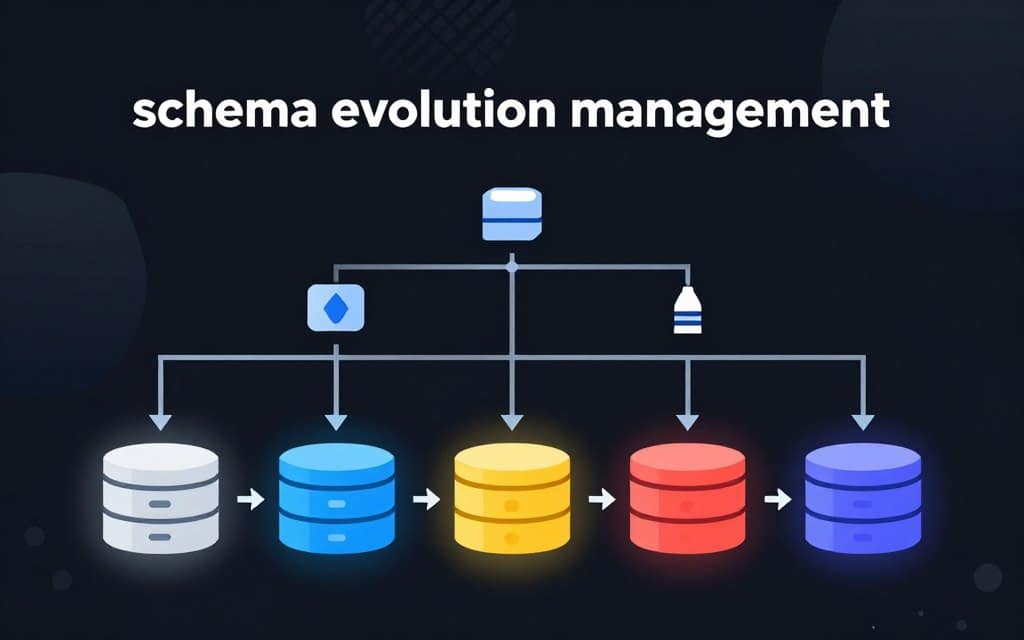
Your event schemas aren’t static documents—they’re living contracts that must evolve alongside your business. Poor management of these changes can silently break compatibility between your services.
You need strategies that allow growth without disruption. The goal is seamless evolution, not painful migrations.
Best Practices for Handling Schema Changes
Always include a version field in every payload. This allows consumers to handle different formats during transitions.
Use additive changes rather than breaking modifications. Add new optional fields while keeping existing ones intact.
This approach gives teams time to adopt updates at their own pace. You avoid forcing simultaneous deployments across dozens of services.
Implement a central schema registry to enforce compatibility rules. This catalog prevents producers from publishing incompatible schemas.
Automate validation in your CI/CD pipeline. Code that breaks backward compatibility should fail before reaching production.
Establish clear deprecation policies with ample migration windows. Monitor usage before removing old field support entirely.
Test changes thoroughly in staging environments first. Discover incompatibilities before they impact your production systems.
This disciplined approach ensures your architecture remains robust through continuous evolution. Your systems adapt without breaking.
Crafting Clear Event Naming Conventions and Payloads
Have you ever spent hours debugging an integration only to discover the problem was vague event names? Clear communication between your services starts with precise language. Your event names and payloads form the foundation of a reliable system.
Defining Consistent Naming Patterns
What’s the difference between “DataUpdate” and “OrderShipped”? The second name tells a complete story. Adopt the pattern using past tense.
Names like “UserRegistered” or “PaymentProcessed” are self-documenting. They instantly inform consumers about what happened and to which entity. This consistency reduces confusion across teams.
Never confuse commands with events. Commands are instructions like “ShipOrder”—they tell a specific service what to do. Events are announcements like “OrderShipped”—they tell everyone what already occurred.
Designing Efficient and Maintainable Payloads
How much data should your events carry? Include only what consumers need to act. Avoid dumping entire database rows into every message.
Your payloads should be lean but sufficient. Use formats like Avro for high-volume streams and JSON for human readability. Ensure schemas are well-documented and consistent.
| Practice | Effective Approach | Problematic Pattern |
|---|---|---|
| Naming | OrderCreated, UserUpdated | Event1, DataChange |
| Payload Size | Essential context only | Full row duplication |
| Format Choice | Avro for efficiency, JSON for clarity | Single format for all cases |
| Intent Clarity | Events (past tense), Commands (imperative) | Mixing event and command semantics |
Establish these conventions early. Clear naming and efficient payloads create a robust foundation for your entire architecture. They prevent technical debt and simplify future changes.
Real-World Success Stories in Event-Driven Data Architecture
Netflix’s instant search results and Uber’s seamless ride matching aren’t magic—they’re powered by sophisticated change capture systems. These companies process billions of daily events while maintaining perfect data consistency.
Insights from Netflix, Airbnb, and Uber
Netflix built DBLog to capture every modification from their production systems. This approach streams changes to search indexes within sub-second latency.
When you search for content, DBLog ensures results reflect the latest metadata. The platform handles massive scale without impacting source performance.
Airbnb developed SpinalTap specifically for listing availability synchronization. Without real-time updates, customers might book unavailable properties.
Their system monitors MySQL binlogs across hundreds of databases. It guarantees zero data loss while feeding multiple downstream services.
Uber’s architecture demands extreme reliability during ride requests. Multiple microservices need consistent views of driver locations and user accounts.
These examples demonstrate proven scalability with relational systems. You can achieve similar results without exotic technology stacks.
Strategic Considerations for Modern Data Teams
Success with modern data flows isn’t about choosing the right technology—it’s about building the right organizational capabilities first. This approach requires strategic commitment, not just technical implementation.
You’ll need buy-in from multiple teams. Backend engineers implement patterns, infrastructure teams run connectors, and analytics teams consume the streams. This cross-functional collaboration is essential.
Start by identifying your highest-value use cases. Real-time fraud detection, personalized recommendations—whatever demonstrates clear ROI. Prove the value with one critical workflow before expanding.
Consider your current capabilities. Existing Kafka setups make integration straightforward. Starting from zero? Managed services reduce operational burden significantly.
Budget for ongoing governance. As more teams publish events, you’ll need registries, catalogs, and monitoring dashboards. Someone must own architecture standards across the organization.
The payoff is substantial. Companies with mature approaches report faster development and improved system resilience. They support real-time use cases that competitors can’t match.
Building a Sustainable and Scalable Data Architecture
Sustainable scalability means designing your data flows to accommodate unpredictable growth patterns. Your systems must handle sudden spikes without collapsing under pressure.
This requires careful planning from day one. You’re building foundations that support exponential user growth.
Balancing Performance with Flexibility
Your architecture needs both speed and adaptability. Poor payload design crushes throughput and inflates costs unnecessarily.
Choose serialization formats strategically. JSON works for low-volume events, but high-throughput streams need compact binary formats.
Partition streams intelligently for horizontal scaling. Group by customer_id or region to parallelize processing efficiently.
Monitor your data flows as rigorously as APIs. Track message lag, throughput rates, and error patterns proactively.
Build flexibility into your approach from the start. Consider hybrid database architectures for scalability that blend different strengths.
Your goal is a platform that grows effortlessly with your business. Adding new consumers or sources shouldn’t require complete re-architecting.
Ensuring Robust Governance and Observability in EDA
Without clear ownership and monitoring, your event-driven approach risks collapsing under its own complexity. Multiple teams publishing independently creates chaos—duplicate events, inconsistent payloads, and nobody knowing which stream to consume.
Establish strong governance from day one. Assign clear ownership for each event type. The team managing a service should own its events completely.
Implementing Effective Monitoring and Logging Tools
Observability isn’t optional—it’s essential for production reliability. Use Prometheus and Grafana to track event throughput and consumer lag. Monitor processing latency across your entire topology.
Implement OpenTelemetry for tracing individual events through your system. When issues arise, you’ll see exactly which services handled an event and where failures occurred.
Set up alerts for critical conditions. If your “PaymentProcessed” stream stops or lag exceeds thresholds, you need immediate notification. This prevents customer-impacting issues.
Create a centralized event catalog documenting every event type, its schema, ownership, and business purpose. Even a well-maintained wiki works initially for better team collaboration.
Monitor for common anti-patterns: oversized payloads, validation errors, or services not acknowledging messages properly. Regular architectural reviews prevent incompatible schemas from reaching production.
Final Reflections on the Future of Data Integration
Real-time responsiveness is no longer a luxury—it’s the competitive edge that separates market leaders from followers. The old batch-processing mindset creates delays that hurt your business opportunities.
Modern architectures deliver information instantly. This approach transforms how your applications serve customer needs. You build features that poll-based competitors cannot match.
The benefits are immediate. Reduced system strain and sub-second latency become your new normal. Your microservices and API endpoints work with fresh data constantly.
Start with one critical workflow. Prove the value before expanding across your entire system. The technology barrier keeps dropping—managed services make adoption straightforward.
The question isn’t whether to embrace this shift. It’s how quickly you can implement it before competitors gain the advantage. Your existing infrastructure can support this evolution today.